
Scary Baboon Reimagined Beginner Guide: Objective and How to Survive Your First Rounds
Scary Baboon Reimagined's objective is to survive the abandoned lab and get away from its monsters. Learn the scrap-to-gear loop and the quiet, watchful habits that keep new players alive through their first rounds.
Scary Baboon Reimagined drops you into an abandoned lab with monsters roaming the halls, and every system in the game pushes toward one goal: staying alive. This guide gives you the objective in plain terms, then the habits that carry a new player through the first rounds of exploring and scavenging.
Quick answer
Your objective is to survive the abandoned lab and get away from its monsters. In practice that means staying quiet, collecting scrap, selling it at the shop for gear, and not getting caught.
- Keep your movement quiet, since some monsters react to every step.
- Watch monsters closely, because some only move when you are not looking at them.
- Collect scrap around the lab and sell it at the shop for gear.
- Avoid getting caught by staying out of monsters' reach.
What Scary Baboon Reimagined is
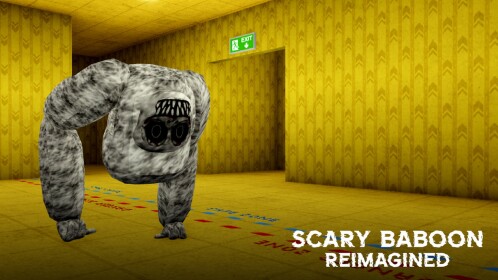
Scary Baboon Reimagined is a Roblox remake of the VR game Scary Baboon by Enver Studio LLC, and it credits the original on its game page. You and other players start trapped inside an abandoned laboratory, and you are not alone: monsters roam the halls, and each one hunts in its own way. Some hear every step, some only move when you look away, and some guard the elevators.
That mix of hunting styles is what the whole game is built around. You get through the lab by learning how each monster behaves and moving accordingly — the game rewards staying quiet and not getting caught.
The objective, stated plainly
The game's own description frames the goal as surviving the abandoned lab and getting away from its monsters, and the experience is tagged with Escape. What it does not describe is the exact conditions for winning or ending a run — those details live in the in-game prompts, so treat what the game shows you during a run as the authority on how it ends.
For a first session, that ambiguity matters less than it sounds. The objective translates directly into everyday play: stay quiet, stay out of reach, keep scavenging, and keep turning what you find into gear that helps you survive longer. A session where you stay alive and come out better equipped than you started is a successful round by the game's own loop.
How your first rounds should go
The game lays out a clear starting route for new players, and it is worth following exactly until quiet movement becomes second nature:
Checklist
- Explore the lab carefully and keep your movement quiet
Make quiet movement your default. Some monsters react to every step, so noise can get a new player noticed quickly.
- Collect scrap while watching for monsters
Scrap is scattered around the lab, but no piece of loot is worth stepping into a monster's reach — keep watching how the monsters near you behave while you search.
- Sell your scrap at the shop to get gear
The shop is where your finds turn into coins and equipment, and equipment is what keeps you alive.
- Team up with friends to stay alive
You can survive together as you move through the halls.
The four steps feed each other. Scrap you collect becomes coins at the shop, the shop's gear is what keeps you alive, and staying alive is what lets you head back out for more scrap. The quieter you are in the first step, the more scrap you actually live to sell in the third.
For each leg of the route in more depth, the lab exploration guide covers careful exploring, and the dedicated pages on finding scrap and selling scrap break the scavenging half into detail.
Learning each monster's hunting style
Because every monster hunts differently, one behavior is not safe everywhere. The game calls out three hunting styles, and each has a matching response:
| Monster hunting style | How you answer it |
|---|---|
| Some monsters hear every step | Keep your movement quiet — your steps are the cue these monsters react to. |
| Some monsters only move when you look away | Watch monsters closely — keeping your eyes on this type is what holds it still. |
| Some monsters guard the elevators | Treat elevator areas as guarded ground and stay out of their reach. |
The behavior that covers every style is distance: avoid getting caught by staying out of monsters' reach. Whatever senses a monster uses, it has to get to you to catch you, and keeping your distance is the habit that outlasts any single encounter. Watch how each monster behaves before committing to a hallway — whether it tracks your steps or your gaze decides how you move around it.
For the full cast and per-monster behavior, start with the Scary Baboon Reimagined monsters overview — the sound-sensitive monsters, look-away monsters, and elevator monsters each have their own breakdown. If you would rather learn the lab without a crowd, the solo survival guide covers careful solo habits.
Scrap, coins, and the shop
Scavenging is your income, and it works through one relationship: scrap is collected around the lab, sold at the shop, and the sale earns you coins while supplying you with gear. That scrap-to-shop pipeline is the economic engine behind every run — collecting, selling, and gearing up is what keeping yourself alive actually looks like, moment to moment.
Where to go deeper: how to find scrap covers the collecting side, how to sell scrap covers the shop side, how to get coins follows the money, and the shop guide explains what you are earning it all for.
Surviving with friends
Teaming up is part of the core loop, not an optional extra: you can team up with friends to survive together, and the starting route ends on exactly that note — team up with friends to stay alive as you move through the halls. For the practical side of setting up a session, see how to play with friends.
Where to go next
Once quiet movement and the scrap-shop loop feel routine, the natural next steps are learning the lab's layout in the all-maps overview, browsing the full item list so you know what gear exists, and checking which equipment is worth your coins in the best gear guide. Monsters are the other half of the game — the sooner you can identify each hunting style by watching how it behaves, the sooner scavenging stops feeling like a gamble.
Related Guides
How to Find Scrap & Stay Hidden
Find scrap efficiently room by room, and keep monsters from noticing you while you carry it out.
How to Sell Scrap for Coins
Turn collected scrap into coins at the shop: where to sell, what it pays, and how coins fund your gear.
Monster Threats: Sound, Look-Away & Elevators
Learn the three described monster hunting styles — sound, look-away and elevator guarding — and how to respond to each one.
All Maps: Lab & Backrooms
See every playable area confirmed so far: the laboratory and the Backrooms, and what makes each one different.